

Priya Nakamura, Staff Writer.
She’s standing in front of the bathroom mirror at 7 a.m., swiping on the same deodorant she’s used for years, and by the 2 p.m. meeting she’s pulling her arms tight to her sides anyway. The drawer under the sink tells the story: three half-used sticks, two clinical-strength versions, one she bought after a friend swore by it. The question she actually types into her phone isn’t “best deodorant” anymore. It’s closer to “why doesn’t my deodorant work by the afternoon.” The honest answer has less to do with the product and almost everything to do with when and how it’s applied. A 2019 study in the British Journal of Dermatology found that antiperspirant actives work best when applied to dry skin at night, a detail almost nobody follows and almost every label buries in fine print.
- Timing beats strength: applying at night, on fully dry skin, lets active ingredients form a more effective barrier than a rushed morning swipe.
- Clinical strength isn’t a fixed standard: the term describes a formulation category, not a regulated potency, so results still depend on application and skin type.
- Sweat and odour are two different problems: treating one doesn’t fix the other, which is why so many routines quietly fail by mid-afternoon.
Why Deodorant Quits By Mid-afternoon
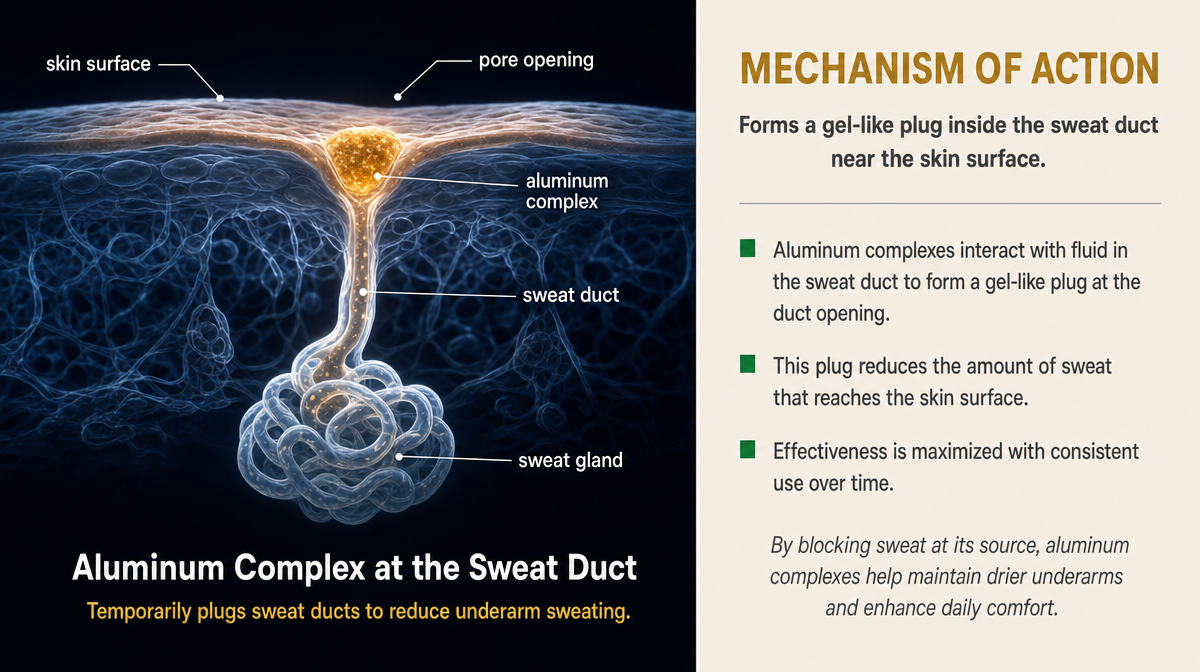
Sweat glands under the arms don’t take orders from a calendar. They respond to heat, stress hormones, and the body’s need to regulate temperature, and by early afternoon, cortisol and activity have usually pushed output higher than it was at 7 a.m. Clinical strength antiperspirants work by forming temporary plugs, usually aluminum-based complexes, inside the sweat duct. Think of it the way an umbrella works in rain: it doesn’t stop the storm, it just redirects where the water goes. A morning application on skin that’s still damp from the shower is like opening a wet umbrella, the seal never quite forms. A 2020 review in the Journal of the American Academy of Dermatology noted that antiperspirant efficacy drops measurably when applied to hydrated skin, because moisture interferes with how the aluminum complex binds to the duct lining. By the time the workday’s stress and heat catch up, the plug has already loosened, and sweat finds its way around it. This is why so many people report that a product worked in week one and stopped working by week three: it’s rarely the formula changing, it’s the application window slipping back into old habits. Reapplying more product doesn’t compensate, because the mechanism isn’t about volume, it’s about the seal forming correctly in the first place. Understanding this one point changes how a routine should be built, since it moves the whole ritual out of the rushed morning bathroom and into the calmer minutes before bed.
Applying At Night Changes Everything

The method is simple enough to build into an existing routine within a few days. After the evening shower or wash, dry the underarm completely, patting rather than rubbing, and wait a few minutes before applying. Skin needs to be fully dry, not just towel-dry, because any residual moisture interferes with how the active ingredient sets. Apply a normal amount, the same as a morning swipe, directly to clean, dry skin, then leave it undisturbed overnight. A morning application can still follow as a light top-up, but it’s the nighttime dose that does the structural work of forming the duct seal. Some people notice mild tingling or tightness the first few nights, which usually settles as skin adjusts; if irritation persists beyond a week, that’s worth discussing with a pharmacist or physician rather than pushing through it. This single change, moving the primary application from morning to night, is one of the few adjustments backed by consistent findings across multiple formulation studies, and it costs nothing extra. It also solves a scheduling problem: most people have more unhurried minutes before bed than during a 7 a.m. scramble, so the routine that actually gets followed tends to be the nighttime one. Consistency matters more than any single ingredient list, since a duct seal that never fully forms won’t hold regardless of what’s inside the container.
Antiperspirant Or Deodorant: Knowing Which Job You Need Done
The two words get used interchangeably at the drugstore shelf, but they solve different problems. Deodorant addresses odour, usually by targeting the bacteria on skin that break sweat down into the compounds that smell unpleasant. Antiperspirant addresses the sweat itself, temporarily reducing how much reaches the skin surface. Clinical strength formulas are almost always antiperspirants first, deodorants second, built around a higher concentration of aluminum-based actives than standard formulas. For someone whose main complaint is visible sweat marks on clothing, an antiperspirant-forward product is doing the right job. For someone whose main complaint is odour by the afternoon despite dry underarms, the sweat volume was never the problem, and a fragrance-forward deodorant, used correctly, may serve better than a stronger antiperspirant. Reading the active ingredients panel settles the question in seconds: if it lists an aluminum compound, it’s functioning as an antiperspirant regardless of what the front label calls it. Matching the product category to the actual complaint, rather than reaching for whatever says clinical strength, prevents a lot of the disappointment people report after switching.
Where The Marketing Outruns The Science
Packaging language moves faster than the underlying formulation science, and a few terms deserve a skeptical read. “48-hour protection” describes laboratory testing conditions, often a single controlled sweat challenge, not a guarantee across a full day of heat, exercise, and stress. “Detox” claims around deodorant have no accepted clinical definition and aren’t required to meet any testing standard to appear on a label. “Natural” or “aluminum-free” describes what’s absent, not what the product actively does, and plenty of aluminum-free formulas work well for people whose main issue is odour rather than sweat volume. What holds up under scrutiny is the active ingredient list and its concentration, the vehicle it’s suspended in, since stick, gel, or spray affects how evenly it spreads and how long it stays put, and independent formulation testing rather than in-house marketing claims. Consumer-testing groups like Protégez-Vous have long applied laboratory protocols to household products in Quebec, and the general principle their model reflects, that a claim printed on a box isn’t the same as a measured result, applies just as well here. A reader doesn’t need a lab. She needs to know which three or four words on the label actually describe a mechanism, and which ones are simply mood.
The Mistakes Almost Everyone Makes
A few habits undercut even a well-chosen product. Applying immediately after shaving irritates skin that’s already slightly compromised, which can cause stinging and, paradoxically, make people apply less consistently because it’s uncomfortable. Waiting even fifteen minutes after shaving reduces this considerably. Applying to skin that’s still warm and damp from a hot shower, as covered earlier, interferes with how the active ingredient sets. Over-applying doesn’t extend protection, since the duct can only accept so much of the active complex before the excess simply sits on the skin surface and transfers to clothing instead. Switching products every few weeks in search of something stronger resets the skin’s adjustment period each time, so a person may never give any single formula the two-to-three-week window most active ingredients need to reach their full effect. Layering fragrance, body lotion, and deodorant on the same patch of skin can also cause the actives to interact unpredictably, sometimes reducing efficacy and sometimes increasing irritation. The fix for most of these mistakes isn’t a different product, it’s slowing the routine down: shave the night before if possible, dry skin fully, apply once in a measured amount, and give a formula a fair trial period before deciding it isn’t working.
Judging Whether It’s Actually Working
Judging a routine fairly takes a short, deliberate test rather than a gut feeling on a single bad day. For one work week, apply the same product at night on dry skin, skip switching products mid-week, and keep a short daily note: whether clothing showed sweat marks by early afternoon, whether odour was noticeable by 3 p.m. even after a normal day, and whether skin felt irritated or comfortable. A single hot or stressful day will always produce more sweat than any formula can fully manage, so judge the pattern across five days, not one outlier. If sweat marks and odour are both still showing up consistently by the end of the week despite correct nighttime application, that’s a genuine signal the formula or the category, antiperspirant versus deodorant, is mismatched to the actual problem, not a signal to apply more of the same product more often. If irritation appears instead of improvement, that’s worth raising with a pharmacist before continuing. This kind of short, structured trial gives a clearer answer in five days than months of switching products based on how one particularly sweaty Tuesday felt.
Building A Routine That Survives A Real Day
A deodorant routine doesn’t operate in isolation from the rest of the day. Synthetic fabrics like polyester trap heat and moisture against skin more than natural fibres like cotton or linen, so the same formula can perform noticeably differently depending on what’s layered over it. Stress sweat, produced by apocrine glands under emotional pressure, tends to be more concentrated and odour-prone than sweat produced simply from heat, which means a stressful presentation day will test a routine harder than a warm but calm one, regardless of product strength. For exercise, applying well before a workout rather than immediately after showering gives the active time to set before heavy sweating begins. None of this means the routine needs to be complicated. It means matching expectations to the day: a nighttime application on dry skin, a light morning top-up if needed, breathable fabric where possible, and reapplication genuinely reserved for unusually demanding days rather than a daily habit that suggests the base routine isn’t holding. Publications like Chatelaine and Canadian Living have covered fabric choice and sweat management as part of broader wellness coverage for years, reflecting how much of this comes down to ordinary daily variables rather than any single product decision.
When Sweating Is More Than A Deodorant Problem
For a small number of people, no routine adjustment fully solves the problem, because the underlying sweat volume is simply higher than clinical-strength products are designed to manage. This condition, hyperhidrosis, affects an estimated 2.8 percent of the population according to figures cited in dermatology literature, and it’s a legitimate medical concern rather than a failure of effort or product choice. Public guidance from the Canadian Dermatology Association describes hyperhidrosis as excessive sweating beyond what’s needed for temperature regulation, and outlines that treatment options beyond over-the-counter antiperspirants exist, including prescription-strength formulations, iontophoresis, and in some cases injectable or surgical treatments for severe cases. The practical signal to watch for is sweating that soaks through clothing daily regardless of temperature, stress level, or product used, especially if it’s been a lifelong pattern rather than a recent change. That distinction, lifelong and severe versus situational and manageable, is usually enough to know whether the fix belongs in the bathroom cabinet or in a conversation with a family doctor. Most people reading this fall into the first category, where the adjustments above make a measurable difference within two to three weeks.
Key Takeaways
- The single biggest lever is timing: apply to fully dry skin at night, not a rushed morning swipe.
- Clinical strength describes a formula category, not a guaranteed result; application still decides how well it performs.
- Antiperspirant and deodorant solve different problems, and matching the right one to the actual complaint matters more than strength.
- Marketing terms like “48-hour protection” or “detox” describe testing conditions or nothing measurable at all, not a guarantee.
- A five-day structured trial gives a clearer read on whether a routine works than judging by a single sweaty day.
Quick Checklist
- Dry underarms fully, pat rather than rub, before any application.
- Apply the primary dose at night, with a light top-up in the morning if needed.
- Shave the night before, not immediately before applying.
- Choose antiperspirant for sweat volume, deodorant for odour, based on the active ingredients list, not the front label.
- Give any formula two to three weeks before judging it, and track results across five days rather than one.
- If sweating soaks through clothing daily regardless of product or effort, raise it with a family doctor.
This article is for general information only and is not a substitute for professional medical advice.
Individual results vary from person to person.