
Devinder Sandhu, Senior Health and Science Editor.
You are standing in front of the bathroom mirror, and behind you, on the shelf, sit four half-used bottles of eau de parfum that all seemed perfect in the store and wrong by the second wear. You type the question into your phone anyway: what actually makes one eau de parfum better than another. The honest answer has less to do with the brand on the label than with a handful of things you can check yourself, in under a minute, before you ever open your wallet. Here is one fact to start with: the word “parfum” on a bottle tells you almost nothing about quality. It tells you a concentration range, set by industry convention, not a guarantee of how it will wear on your particular skin.
- Concentration is a range, not a promise: “eau de parfum” typically means 15 to 20 percent aromatic compound, but two EDPs at that same strength can behave completely differently on skin.
- Testing takes hours, not seconds: a fragrance you judge in the first two minutes in a department store is not the fragrance you will wear at 6 p.m.
- Your skin is part of the formula: pH, oil level and even medication change how notes read, which is why a scent that is stunning on a friend can fall flat on you.
Reading The Label: What “Eau De Parfum” Actually Promises
Perfume houses classify their products by the percentage of aromatic compound dissolved in alcohol and water. Eau de parfum generally sits between 15 and 20 percent, eau de toilette between 5 and 15 percent, and pure parfum can run higher still. This is an industry convention, not a regulated legal standard in Canada, so two bottles both labelled eau de parfum can carry different actual concentrations.
A higher percentage usually means the scent lasts longer and projects more, but it does not tell you whether the underlying formula is well balanced. A poorly blended EDP will just be a poorly blended scent that lingers longer.
Self-test: before buying, look for the concentration printed near the barcode or on the box. If it is not listed, that omission itself is useful information: brands proud of a high concentration tend to print it.
How A Fragrance Actually Unfolds On Skin
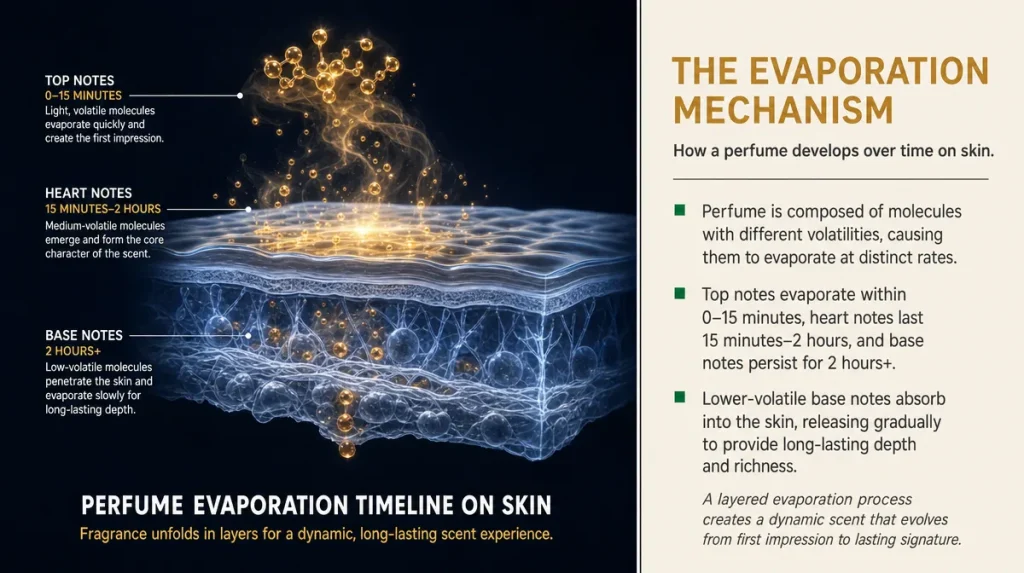
A fragrance is not one smell, it is a sequence. Alcohol carries the lightest, most volatile molecules to your nose first: these are the top notes, often citrus or light florals, and they evaporate within 10 to 15 minutes. Underneath, heavier molecules bound loosely to your skin’s natural oils release more slowly, forming the heart notes over the next hour or two. What remains after four to six hours, the base, is usually built from heavier materials such as woods, resins or musks.
Think of it like a pot of soup left to simmer. The first thing you smell when you walk into the kitchen is the sharp, fast burst of garlic hitting hot oil. An hour later, that smell is gone, replaced by the slower, rounder smell of the stock itself. Judging a perfume only by that first minute is like judging the soup by the garlic alone.
This is also why a fragrance that smells thrilling on a paper blotter can feel underwhelming, or completely different, once it meets the warmth and oils of your skin.
Testing On Paper First, Then On Skin
Start on a blotter strip, not your wrist, and not the air. Spray once, wait 30 seconds for the alcohol to clear, then smell. This tells you the top notes without any interference from your own skin chemistry or from the six other fragrances you likely walked past to get to the counter.
If you like what you smell on paper, apply it to a pulse point, ideally the inner elbow rather than the wrist, since the inner elbow sees less hand-washing and rubbing that can disturb the drydown. Then leave the store. Run your errands. Check back at the one-hour mark and again after four to six hours.
The mistake almost everyone makes is buying based on the first 90 seconds in a bright, scent-saturated shop. A 2019 review in the International Journal of Cosmetic Science noted that olfactory fatigue sets in quickly when multiple fragrances are sampled in succession, meaning the fifth scent you try will always seem fainter and less distinct than the first, regardless of its actual quality. Testing one scent per outing, on skin, over hours, remains the only reliable method.
Longevity And Sillage: How To Measure Instead Of Guess
Longevity is how long you can still smell the fragrance on your own skin. Sillage, from the French word for wake, is how far it projects to people around you. The two are not the same, and a fragrance can have excellent longevity while sitting close to the skin, or strong sillage that fades within two hours.
To measure honestly: apply at a consistent time, note it, then check at the two, four and eight hour marks by smelling your own wrist directly, and separately by asking whether someone standing an arm’s length away can detect it without leaning in. Write both down. Over a few wears you will notice patterns specific to your skin, since a study in the Journal of Cosmetic Science examining skin hydration and lipid levels found that drier skin tends to hold fragrance oils less effectively than well-moisturized skin, which is one reason the same bottle performs differently season to season.
A practical habit: apply eau de parfum right after a shower, on slightly damp, moisturized skin, rather than on dry skin at the end of the day. It visibly extends wear for most people without changing the product itself.
Natural, Synthetic And What The Marketing Wants You To Believe
Marketing copy leans hard on words like rare, natural and pure. In practice, most modern fragrances, including expensive ones, rely heavily on synthetic aroma molecules, and this is not a mark of lower quality. Synthetics allow perfumers to stabilize scents that would otherwise be inconsistent from batch to batch, and they make possible entire categories of smell, such as clean musk or fresh ozonic notes, that do not exist in nature to be extracted at all.
What actually matters more than natural versus synthetic is the skill of the blend and the quality of the raw materials chosen, whichever category they fall into. A cheaply made synthetic can smell thin and one-dimensional; a well-composed one can be extraordinarily rich and long-wearing.
Be skeptical of claims tied to exotic single ingredients presented as the reason to pay a premium. The actual formula is almost always a blend of dozens of components, and no single rare flower is doing all the work, regardless of what the packaging suggests.
Why The Same Bottle Smells Different On Two People

Skin is not a neutral surface. Its pH, oil production, hydration level, and even certain medications and dietary habits change how fragrance molecules bind and evaporate. This is why a scent adored by a friend can read as sharper, sweeter or simply different on you.
Self-test: apply the same fragrance to both wrists at the same time, then compare how each side smells after 60 minutes. Most people notice a subtle but real difference between their own two wrists, which is a useful reminder of just how much individual chemistry contributes.
This is also the practical argument for never buying a fragrance based solely on how it smelled on someone else, no matter how good the description sounded. A recommendation from a friend is a reasonable starting point for what to test, never a substitute for testing it on your own skin.
Sensitivities, Patch Testing And Safe Layering
Fragrance is one of the more common causes of contact skin irritation, and general public guidance from the Canadian Dermatology Association notes that individuals with sensitive or eczema-prone skin may want to patch test new fragranced products on a small area before regular use, and to watch for redness, itching or a rash over 48 hours.
If you have reacted to fragrance before, apply a small amount to the inner forearm and wait two days before using it more broadly, rather than spraying directly onto the neck and décolletage the first time.
A common mistake is layering a heavily scented body lotion under an eau de parfum. This does not always deepen the scent as intended; it sometimes muddies the top notes or intensifies certain molecules to the point of irritation for sensitive skin. If you want the fragrance to last longer, an unscented, ordinary moisturizer beneath it is usually the safer route, since damp, hydrated skin holds fragrance oils better without adding a second competing scent.
Building A Wardrobe Instead Of Chasing One Bottle
Most people do not need one perfect eau de parfum, they need two or three that suit different seasons and settings. Heavier, warmer compositions with amber, wood or spice tend to read as too intense in humid summer heat, while lighter citrus or green fragrances can feel thin against cold, dry winter air.
Give any new bottle at least two to three separate wears across a week before deciding, rather than a single test spray in a store. Scent memory is unreliable in the short term, and how a fragrance sits with you on a stressful Tuesday can differ from how it reads on a relaxed Saturday.
Store bottles away from bathroom humidity and direct sunlight, both of which visibly shorten a fragrance’s shelf life by degrading the aromatic compounds over time. A dresser drawer or closet shelf, away from heat, keeps a bottle performing closer to how it smelled the day you bought it, for longer.
Key Takeaways
A concentration percentage tells you roughly how long a fragrance may last, not whether it is well made. Judge a scent over hours, not the first minute in a store, and always test on your own skin rather than trusting how it read on someone else. Natural is not automatically better than synthetic, and rare-ingredient marketing rarely reflects how a formula actually works. Skin chemistry, hydration and even the weather all change how a fragrance behaves, which is why building a small seasonal wardrobe tends to serve most people better than searching for one universal bottle.
A Practical Checklist Before You Buy
- Check the printed concentration if available, and note that eau de parfum typically means 15 to 20 percent aromatic compound.
- Test on a blotter first, then on the inner elbow, never only in the air of a busy store.
- Wait at least four hours, and ideally leave the store, before judging the full development of a scent.
- Compare both wrists if you are testing more than one option at once.
- Patch test on the inner forearm for 48 hours if you have reactive or sensitive skin.
- Apply to clean, hydrated skin rather than dry skin for more even, longer wear.
- Store bottles away from bathroom humidity and direct light.
- Give any promising bottle two to three separate wears across a week before deciding.
This article is general information and does not replace individual advice from a dermatologist or allergist.
Results and skin reactions vary from person to person.