
Alison Fournier, Beauty Editor.
You’re standing at the bathroom mirror doing the thing everyone does before a school run or a work call: three coats on the left eye, four on the right, wondering why one side still looks thinner no matter how much you tug at the wand. The drawer under your sink probably holds three or four half-used tubes bought on the promise of instant volume, most of them dried out by month two. Here is a fact worth knowing before you buy another: the average person has somewhere between 90 and 160 lashes per upper eyelid, and that number, not the brush shape on the shelf, sets the real limit on how much volume any formula can add. This guide walks through what genuinely thickens a lash line, what is clever copywriting, and how to test a mascara’s real performance in the first thirty seconds of wear.
- Fibre-and-polymer formulas build real width, not just a darker coat. Controlled wear studies show measurable diameter gains from fibre-based formulas, while protein-only formulas mostly change texture rather than volume.
- Brush shape and bristle spacing predict performance better than the label does. A ten-second hand-test shows whether a wand deposits heavily or thinly before it ever touches a lash.
- Three months is the real shelf life, not a marketing suggestion. The closed, moist environment inside an opened tube lets bacteria multiply with every use, which is why old mascara stops performing and starts to irritate.
What “Volumizing” Actually Means On The Wand
Every lash already has a shape and diameter that genetics decided long before any tube of mascara entered the picture. A formula can only do two things to change how that lash looks: coat it, or bridge it to its neighbours. Coating adds a thin layer of wax, polymer or oil around the shaft, the way a coat of paint makes a picture frame look a little thicker. Bridging uses fine fibres, usually nylon or rayon, that catch between lashes and stack width across the whole lash line rather than around a single hair.
Most volumizing formulas on drugstore and department shelves lean mainly on coating, because it is cheaper to manufacture and does not shed. Fibre-based formulas that do the bridging tend to look dramatically thicker in photos, but they also flake more, since the fibres are only mechanically caught on the lash rather than chemically bonded to it.
Think of a fence post that looks thin from a distance. Painting it a darker colour makes it look a bit sturdier. Wrapping string around it in loops, layer after layer, actually adds width you could measure with a ruler. Both change the appearance. Only one changes the physical diameter. Volumizing mascara works the same way: some tubes paint, some wrap, and knowing which one you are holding tells you what kind of volume you are paying for.
Reading The Brush Before You Read The Label
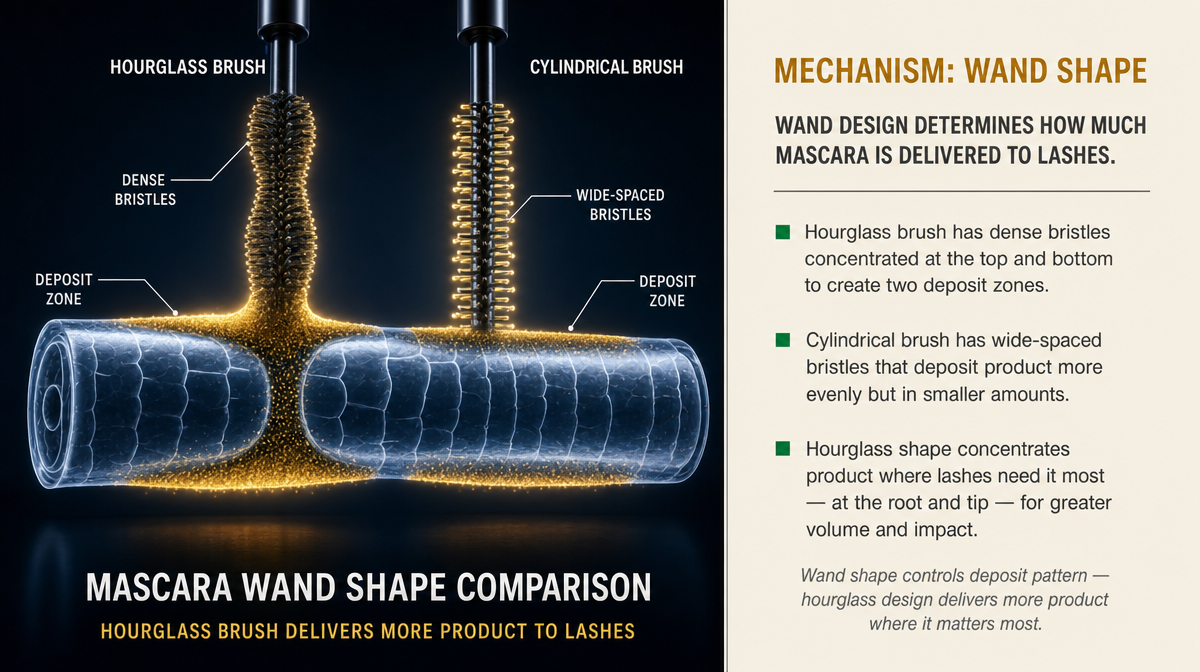
The label rarely tells you what a brush will do to your particular lash pattern, and brush shape matters more than most shoppers assume. An hourglass shape, narrow in the middle and wider at both ends, is built to add volume at the outer corner and length at the inner corner in a single stroke. A straight cylindrical brush with tightly packed bristles deposits more product per stroke, which reads as volume but can also clump on shorter, straighter lashes.
Widely spaced bristles comb through lashes and separate them, useful for length and definition but weaker for building visible thickness. Densely packed bristles push more formula onto each lash, closer to the bridging effect described earlier.
Here is a thirty-second test you can run in a store or at home with a tube you already own: draw the wand once across the back of your hand. A solid, slightly raised line of product means the brush is built to deposit heavily and will likely show more volume. Thin, separated streaks mean the brush is built for definition and length rather than thickness.
Bristle material matters less than shape. Rubber and silicone bristles tend to hold formula longer through the day. Nylon bristles pick up more product per pass but dry out faster once a tube has been open for a few months.
The Ingredients That Build Thickness, And The Ones That Just Claim To
Cosmetic chemists have a fairly short list of ingredients that measurably add bulk to a lash. Waxes, including beeswax, carnauba and candelilla, form the base that holds a mascara’s shape once it dries and gives the coating its thickness. Film-forming polymers, often listed as acrylates copolymer or PVP, create the flexible shell that keeps that thickness from cracking when you blink. Fibres, typically nylon or rayon microfibres a few millimetres long, do the bridging work described earlier.
Then there is a longer, more marketable list of ingredients that sound like they should thicken a lash but mostly cannot. Keratin and collagen appear on many mascara labels, and while both are real structural proteins, the molecules used in cosmetic formulas are generally too large to bond to the hair shaft the way skincare marketing implies. A 2023 study in the Journal of Cosmetic Science, testing a panel of forty women over four weeks, found that fibre-and-polymer combinations produced a measurable increase in perceived lash diameter, while protein-only formulas without fibres or heavy polymers showed no statistically significant difference from a plain coating mascara.
That does not make keratin or collagen useless. They can improve how a formula feels on the lash and may support flexibility, which reduces the flaking that undermines volume over a full day. But a label that leads with protein claims and lists little else in the way of waxes, polymers or fibres is unlikely to match the volume promised on the box by early afternoon.
How You Apply It Changes The Outcome As Much As The Formula
Two people using the identical tube can get noticeably different results, because technique changes how much product ends up on the lash and how evenly it sits. Wiggling the wand at the base of the lashes before pulling upward and outward deposits product at the root, where volume reads most strongly, and helps spread it along the shaft rather than pooling it at the tip.
A single thick coat almost always looks worse than two thin ones. The first coat sets the shape and gives fibres or polymers something to grip. Applying a second coat before the first has dried traps wet product against wet product, which is the most common cause of clumping. Waiting roughly fifteen to twenty seconds between coats lets the film start to set.
Pumping the wand in and out of the tube feels productive but does the opposite of what most people intend. It pushes air into the tube, which speeds up drying and introduces the flaking that shows up by the end of the day. Twisting the wand gently as you remove it, without pumping, picks up enough product without accelerating that process.
Mistakes Everyone Makes At The Mirror
Beyond pumping the wand, a few habits quietly undo whatever volume a formula is capable of giving. Layering a new mascara over yesterday’s dried, unremoved coat adds bulk in the wrong way: it looks clumpy rather than full, because the new formula has nothing clean to bond to. Removing mascara fully each night, even on days when it seems to have held up fine, keeps the lash surface ready to take the next coat properly.
Curling lashes after mascara has already set reverses the right order. Curling should happen on bare lashes, before any product goes on, since curling a coated lash risks cracking the dried film and can pull out lashes already weighed down by product.
Holding the wand too far from the lash line, closer to the eyelid skin than to the root of the lashes, deposits product on skin rather than hair. It also raises the odds of transfer to the lower lid within a few hours, which reads as smudging rather than a flaw in the formula itself.
How To Judge Results Honestly, And By When
Most volume claims are meant to be checked within a narrow window, and reading them at the wrong time gives an unfair picture either way. Check within the first ten minutes of application for flaking or transfer under the eye; a formula that fails this test early rarely improves as the day goes on. Check again eight to ten hours later for smudging along the lower lash line and for whether the lashes still hold their shape.
A full week of daily wear is a fairer test of whether a formula genuinely builds perceived volume over time versus simply coating each lash. Take a photo on day one before applying anything, then another after a week of consistent use, in the same light and from the same angle. Comparing the two side by side removes the memory bias that makes a new product feel more dramatic on day one than it really is.
If irritation, itching or unusual redness develops at any point, that is a signal to stop rather than push through for the sake of a longer trial. The Canadian Dermatology Association’s public guidance on eye-area cosmetics notes that mascara is a common source of minor eye irritation, particularly for contact lens wearers, and recommends discontinuing use if symptoms persist.
What’s Marketing Language, And What’s Measurable
Packaging copy has its own vocabulary, and most of it describes a feeling rather than a mechanism. Terms like lash-lifting technology, instant drama or 24-hour hold are not regulated claims and rarely correspond to a specific, testable ingredient or method. They can still describe a genuinely good mascara, but the words alone prove nothing.
Measurable claims tend to reference a specific test: a percentage increase in lash diameter measured under magnification, a named study with a stated number of participants, or a duration tied to a wear test rather than an adjective. Beauty coverage in outlets like ELLE Canada and Chatelaine occasionally reports on these studies when brands make them public, which is one of the more reliable ways to check whether a volume claim has independent backing separate from the brand’s own advertising.
Consumer-testing groups such as Protégez-Vous in Quebec periodically run comparative lab evaluations of cosmetics, including mascaras, using standardized wear panels rather than marketing photography. Their published methodology, where available, is a useful model for an honest at-home comparison: consistent lighting, a fixed number of coats, and a fixed time window before judging the result.
None of this makes marketing language dishonest by default. It means the words on the front of the tube are not the evidence, and the ingredient list combined with a short trial at home will tell you more than the box ever does.
When To Replace It, And Why Sharing A Tube Is A Bad Idea
Mascara has a shorter safe shelf life than almost anything else in a makeup bag, generally around three months once opened, regardless of how much product remains in the tube. Every pass of the wand in and out introduces air and a small amount of bacteria from the lash line back into the tube, and the closed, moist environment inside a mascara barrel is a reasonable place for that bacteria to multiply.
This is also why sharing a tube, even with a partner or a sister, carries more risk than sharing most other cosmetics. Public health guidance from Canadian dermatology sources generally advises against it, since eye infections spread more easily through shared mascara than through shared lipstick or foundation.
A simple habit helps: write the date you opened a new tube somewhere on the packaging, and treat the three-month mark as a hard stop rather than a suggestion. If the formula starts to dry out, clump or smell different well before three months have passed, that is also a sign to replace it rather than add water or saline to revive it, a shortcut that introduces more bacteria than it solves.
Key Takeaways
Volume comes from two mechanisms only: coating a lash to make it look a little thicker, or bridging lashes together with fibres to add real width across the line. Brush shape and bristle spacing tell you more about likely performance than any word on the box. Application technique, especially thin layered coats and no pumping, changes the outcome as much as the formula itself. Judge results at three points: within ten minutes for flaking, at the end of a full day for smudging, and after a week of consistent use for genuine volume change. Replace every tube at three months, whether or not it looks used up.
A Two-minute Checklist Before You Buy
- Run the wand across the back of your hand: a solid raised line suggests heavier deposit and more visible volume.
- Scan the ingredient list for waxes, film-forming polymers and fibres rather than protein claims alone.
- Skip formulas whose main selling point is an unregulated phrase like “instant drama” with no study or number behind it.
- Apply in two thin coats with a short pause between them rather than one thick layer.
- Check for flaking within ten minutes and smudging by end of day before judging the formula a success.
- Write the open date on the tube and retire it at three months.
This article is general information and does not replace advice from a dermatologist or eye care professional.
Individual results with any mascara formula vary by lash type, application technique and skin sensitivity.