
Devinder Sandhu, Senior Health and Science Editor.
You are standing at the bathroom mirror, iron already warming up, hair clipped into four sections, and the question you actually type into your phone later is some version of: why does my hair look sleek for an hour and frizzy by lunch, or worse, why does it feel thinner at the ends than it did back in September. The shelf under the sink tells its own story. Three flat irons bought over the years, two of them retired because they pulled or scorched, one heat protectant spray that smells nice and does almost nothing measurable.
Here is the fact worth knowing before you spend another dollar: straightening works by temporarily breaking hydrogen bonds inside the hair’s protein structure, and most of the damage people blame on a bad iron actually comes from applying too much heat, for too long, to hair that is still a little damp. Get that one mechanism straight and most of the marketing noise, ceramic versus titanium versus tourmaline, falls away as decoration rather than decision-making.
This guide walks through what the plates are actually doing, how to match heat to your hair’s thickness, the mistakes that quietly cause the most breakage, and how to judge whether a straightening session helped your hair or just hid the problem for a few hours.
- Plate material matters less than temperature control: the coating changes how evenly heat spreads, but an iron with no reliable temperature dial will damage any hair type regardless of what the plates are called.
- Damp hair is the real damage multiplier: water trapped inside the shaft can boil at straightening temperatures, which is what causes the sudden sizzle and the brittle ends that follow.
- One slow, single pass beats five quick ones: repeated passes at lower heat cause more cumulative protein damage than one deliberate pass at the correct temperature for your hair’s thickness.
Why Heat Changes Hair Shape At All
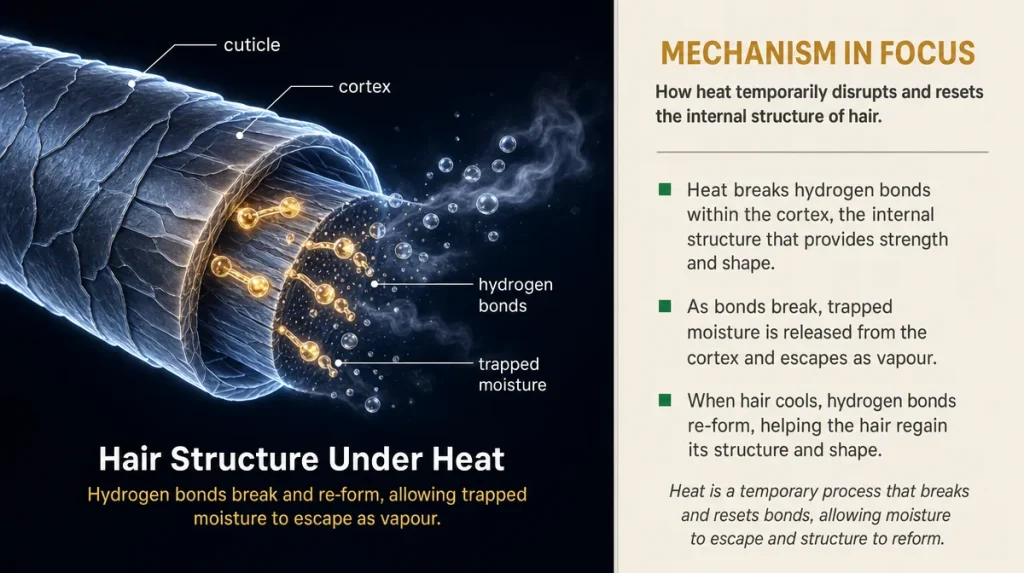
Hair holds its shape through a mix of hydrogen bonds and disulfide bonds inside the protein structure of the cortex. Hydrogen bonds are weak and temporary, the same kind that let a sheet of paper curl in humid air. Heat and pressure break them long enough for the hair to be reshaped flat, and as the hair cools, those bonds re-form in the new, straighter position.
Think of it the way a shirt responds to an iron. The fibres do not change permanently, the shape simply resets until moisture or humidity convinces the bonds to relax again, which is why straightened hair tends to lose its shape first at the hairline and in damp weather. A 2019 study in the International Journal of Trichology measured this bond behaviour directly and found that damage accumulates not from the act of straightening itself but from excess heat applied when the shaft still contains moisture that has nowhere to go.
That is the mechanism worth remembering: it is not heat that damages hair, it is heat meeting trapped water. Everything else in this guide follows from that one fact.
Plate Material: What The Labels Actually Mean
Ceramic, titanium, and tourmaline are marketing shorthand for three different approaches to one real problem: getting heat to spread evenly across the plate instead of concentrating in hot spots.
Ceramic plates heat relatively evenly and are gentler on fine or colour-treated hair, but cheaper ceramic coatings can wear thin after repeated use and expose metal underneath. Titanium plates heat faster and hold temperature better under continuous use, which suits thick or coarse hair that would otherwise cool the plate with every pass. Tourmaline is usually a mineral coating layered over ceramic or titanium, marketed for reducing static through negative ion output, though the measurable frizz-reduction effect is modest and depends heavily on humidity and hair porosity.
None of these materials fixes an iron with poor temperature regulation. A plate that cannot hold a steady temperature across its surface will create hot spots regardless of what it is coated with, and hot spots are where visible breakage starts. When judging an iron, the plate label matters far less than whether the device has a digital temperature readout and maintains that temperature consistently, something you can test at home by running the iron over a few strands at the same setting and feeling for uneven heat along the plate’s length.
Matching Heat To Your Hair, Not The Dial’s Maximum
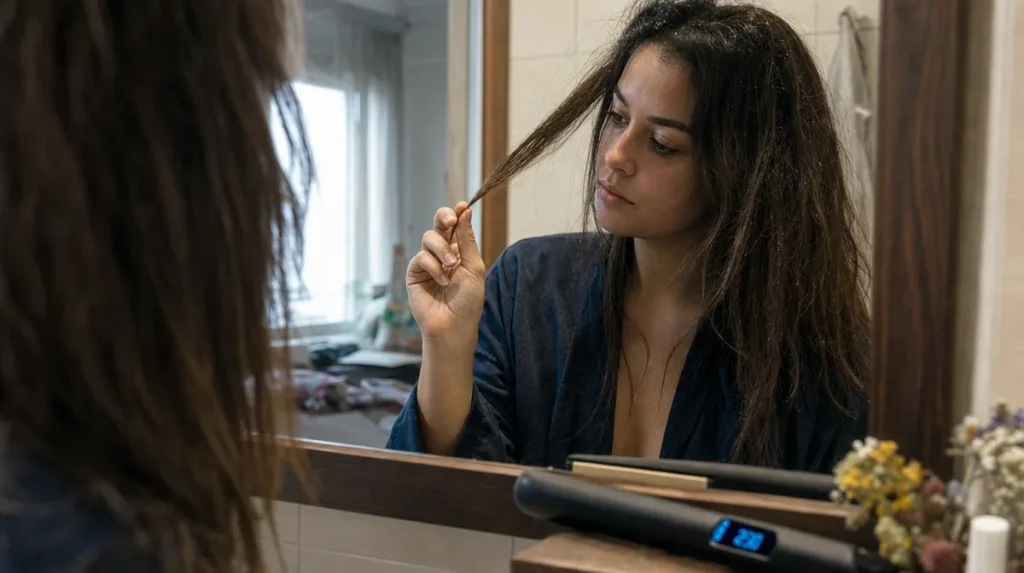
Fine or colour-treated hair generally needs 150 to 180 degrees Celsius, medium hair sits comfortably around 180 to 200, and thick, coarse, or very curly hair may genuinely need 200 to 220 to reshape without multiple passes. Very few heads need the 230-degree ceiling that many irons advertise as a selling point.
A simple self-test: take one small strand, straighten it once at your chosen setting, and check it an hour later. If it has reverted to its original texture, the temperature or technique was too low for that bond strength to hold. If the strand feels dry, rough, or noticeably lighter in colour at the tip compared with the rest, the setting was too high for that hair’s condition.
The mistake almost everyone makes is choosing the highest setting out of impatience, assuming more heat means less effort. In practice it means more passes are needed to compensate for hair that is drying out and resisting the shape change, which compounds the damage rather than reducing it. Hairdressers interviewed in a 2021 Canadian Living feature on heat styling made the same point: slower, lower, and more deliberate beats hot and hurried almost every time.
The Pass Matters More Than The Iron
Speed is where technique quietly decides the outcome. Dragging an iron through hair too quickly forces a second or third pass to finish the job, and each additional pass at the same temperature adds cumulative stress to bonds that have already been broken once.
A single, slow, even pass, roughly two to three seconds per section, gives the heat time to travel through the hair’s full diameter rather than just toasting the surface. Coarser hair sections should be kept narrower, about one to two centimetres, so the heat can reach the centre of the strand rather than only the outer layer.
The common error is sectioning too broadly to save time. A wide section looks straight on the outside while the inner strands remain only partly reshaped, which tempts a second or third pass over the same section, and that repetition is where visible frizz and split ends tend to originate weeks later rather than immediately.
Why Damp Hair Is The Real Risk, Not The Iron Itself
Straightening hair that still has internal moisture is the single most common cause of audible sizzling, and that sound is water inside the shaft turning to steam under pressure. Steam expands rapidly within the hair’s protein layers and can lift or crack the cuticle, the hair’s outer protective layer, leaving the strand rougher and more porous afterward.
Hair should be fully air- or blow-dried before any flat iron touches it, including the sections near the scalp that often feel dry on the surface but hold residual moisture underneath. A quick household comparison: think of searing a wet piece of food in a hot pan. The surface spatters and cooks unevenly until the moisture is gone, and only then does even browning begin. Hair behaves similarly under direct heat.
If you routinely hear sizzling, the fix is rarely a different iron. It is more drying time, a lower heat setting, or both.
What A Heat Protectant Is Actually Doing
A heat protectant is not a shield in the way sunscreen is for skin. Most formulas work by coating the hair shaft in a thin polymer or silicone film that slows moisture loss and reduces direct friction between the plate and the cuticle, buying the hair a few extra degrees of tolerance before damage begins.
The products that perform best in independent testing tend to contain silicones or film-forming polymers applied to towel-dried, not soaking, hair, combed through evenly before any heat tool is used. Spraying protectant onto hair that is already fully dry does very little, since the product needs to settle into the shaft’s outer layer while it is still slightly pliable.
What protectant cannot do is compensate for a setting that is simply too hot for the hair’s thickness. It narrows the margin for error, it does not remove it.
Judging Results Honestly, A Week Later
The day of straightening tells you almost nothing useful, because fresh heat styling looks smooth on almost any hair. The honest test is how the hair looks and feels three to five days later: shine that holds, ends that do not feel rough to the touch, and no new flyaways concentrated specifically at the point where the iron usually stops.
Split ends that appear in roughly the same spot each time, often a few centimetres from the tip, point to a setting that is too hot or a pass that lingers too long at that exact section. Dullness that sets in within a day or two, rather than gradually over weeks, usually signals moisture loss from the shaft rather than ordinary ageing of the style.
If results only ever look good for a few hours and revert quickly in humidity, that is less often about the iron and more often about insufficient drying, a protectant that was applied too late, or hair that needed a slightly higher sustained temperature to properly reset the bonds in the first place.
What Matters And What Is Marketing
Digital temperature display and consistent heat across the plate matter. So does plate width matched to your hair’s length and thickness, since a narrow plate on long, thick hair means far more passes than necessary.
Claims around infrared heat, negative ion counts, or proprietary mineral blends are harder to verify independently and are rarely the deciding factor in how hair actually responds. A 2022 consumer-testing review by Protégez-Vous compared several heat styling tools on even heat distribution and found that stated technology names correlated poorly with measured plate temperature consistency, the factor that mattered most for outcome.
Floating plates, which move slightly to maintain contact across uneven sections, offer a genuine mechanical benefit for anyone with layered or textured hair, since they reduce the gaps where heat fails to reach the strand evenly. Automatic shut-off is a safety feature worth having, not a performance one.
When A Flat Iron Is Not The Right Tool At All
Hair that is already chemically treated, bleached, or showing visible breakage along the shaft is more vulnerable to further heat damage regardless of technique, and repeated daily straightening on compromised hair can outpace the hair’s ability to recover between washes.
The Canadian Dermatology Association’s public guidance on hair and scalp care notes that persistent breakage, scalp tenderness, or thinning along the hairline warrants an in-person assessment rather than a change of styling tool, since those symptoms can have causes unrelated to heat styling entirely. If straightened sections consistently feel gummy, overly elastic when wet, or snap rather than stretch, that is a sign the hair’s protein structure needs a recovery period, not a different iron.
For most people, the simplest long-term protection is spacing out heat styling sessions and alternating with air-dried or low-heat styles, which several Canadian beauty editors, including writers at ELLE Canada and The Kit, have pointed to as the habit that preserves shine longer than any single product change.
Key Takeaways
Temperature control and even heat distribution matter more than the specific plate material or branded technology name.
Fully dry hair before straightening, since trapped moisture, not heat itself, causes most visible damage.
One slow, deliberate pass at the right temperature for your hair’s thickness outperforms several rushed passes at a lower setting.
Judge results three to five days later, not on the day of styling, and watch for recurring split ends at the same point as a sign the setting is too high.
A Quick Checklist Before You Reach For The Iron
- Hair is fully dry, including near the scalp, not just dry on the surface
- Heat protectant applied to towel-dried hair, combed through evenly, before any other product
- Temperature set according to hair thickness, not the highest available setting
- Sections kept narrow enough that heat reaches the centre of each strand
- One slow pass attempted before deciding a second pass is necessary
- Results checked again after three to five days, not judged on styling day alone
This article is general information and does not replace individual advice from a dermatologist or trichologist.
Individual hair response to heat styling varies and results described here may not apply to every hair type.